
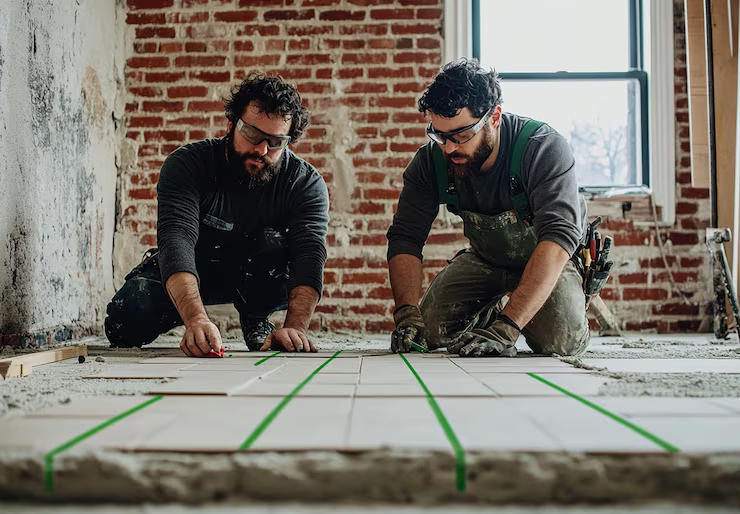
Tile Adhesive vs Mortar: Which One Is Stronger for Floor Tiles? Choosing the right bonding material is essential for installing floor tiles that remain secure for years. In Pakistan, many builders still use traditional cement and sand mortar, while tile adhesive is becoming increasingly popular for modern flooring projects.
Both materials can be effective when used correctly, but they work differently. Their performance depends on tile type, surface preparation, installation thickness, and workmanship.
So, which one is stronger for floor tiles? Let’s compare tile adhesive and traditional mortar to understand which option is better for different flooring requirements.
Table of Contents
What Is Traditional Cement Mortar?

Traditional mortar is generally made by mixing cement, sand, and water. It has been used for decades in residential and commercial construction to install floor tiles.
It is commonly applied as a thicker bed, allowing installers to adjust tile levels and accommodate certain surface variations.
Advantages of cement mortar:
- Materials are widely available in Pakistan.
- Suitable for certain traditional thick-bed installation methods.
- Can help adjust levels when used as part of an appropriate mortar-bed system.
- Familiar to many local construction workers.
Limitations of cement mortar:
- Results depend heavily on mixing proportions and workmanship.
- Incorrect application can lead to inconsistent bonding.
- It may not be suitable for all porcelain and large-format tiles.
- Thick applications can increase material use and installation time.
What Is Tile Adhesive?
Tile adhesive, commonly called tile bond, is a specially formulated material designed to attach tiles to suitable floors and walls.
Cement-based tile adhesives generally contain cement, graded fillers, and additives. Polymer-modified formulations can improve adhesion and working properties for specific applications.
Unlike ordinary cement and sand mixtures, tile adhesives are manufactured with defined application instructions and performance specifications.
Advantages of tile adhesive:
- Controlled factory formulation.
- Convenient mixing and application.
- Suitable options for ceramic and porcelain tiles.
- Available in formulations for large-format tiles.
- More controlled thin-bed installation.
- Some products offer reduced-slip and extended open-time properties.
Tile Adhesive vs Mortar: Which Is Stronger?
There is no universal answer because strength depends on the product, installation method, and surface conditions.
Traditional mortar can provide reliable results in suitable thick-bed installations. However, a properly selected polymer-modified tile adhesive can offer improved bonding performance for modern thin-bed tile installations.
For example, porcelain tiles have low water absorption, making adhesive compatibility particularly important. Using ordinary mortar without considering the tile and installation system can result in bonding problems.
When comparing strength, look beyond the product name. Check documented adhesion performance, tile compatibility, and the manufacturer’s installation recommendations.
Key Differences Between Tile Adhesive and Mortar
1. Bonding Strength
Traditional mortar can provide a strong installation when the correct method and materials are used.
Tile adhesives are formulated specifically for tile bonding. Higher-performance products may provide improved adhesion, particularly for porcelain and demanding installations.
For comparison, EN 12004 class C2 identifies improved adhesion performance for cementitious tile adhesives. It is a useful specification to check when selecting an adhesive.
2. Application Thickness
Mortar is commonly used in thicker beds, depending on the installation system.
Tile adhesive is generally designed for a thinner, more controlled layer. This makes it useful for modern flooring installations where the substrate has already been properly levelled.
Always follow the manufacturer’s recommended thickness. Tile adhesive should not be used to correct major floor unevenness unless specifically permitted.
3. Compatibility With Floor Tiles
Both materials can be used in suitable floor installations.
However, tile adhesive products are available in different formulations for ceramic, porcelain, marble, and other tile materials.
For low-absorption porcelain tiles, choose an adhesive specifically approved for porcelain rather than assuming ordinary mortar or standard adhesive will work.
4. Installation Convenience
Traditional mortar requires careful control of cement, sand, and water proportions.
Most powdered tile adhesives require adding a specified quantity of clean water and mixing according to the product instructions. This helps provide a more consistent material.
Both methods require proper surface preparation and skilled installation.
5. Large-Format Floor Tiles
Large tiles, such as 24×24 inches and above, require careful attention to adhesive coverage.
A suitable high-performance tile adhesive can provide controlled bonding for large-format installations. Back-buttering may also be recommended to improve contact between the tile and adhesive.
StoneBird SB Pro C2TE is one option to consider for large-format tile applications. Its published specifications include C2TE classification and suitability for tiles measuring 600×600 mm and above.
Explore StoneBird SB Pro C2TE.
Which Is Better for Different Floor Tiles?
Ceramic Floor Tiles
Both traditional mortar and suitable tile adhesive can work for ceramic flooring.
Tile adhesive is a convenient option for thin-bed installations, while mortar may be suitable for certain traditional installation systems.
Porcelain Floor Tiles
A tile adhesive specifically approved for porcelain is generally the preferred choice for modern thin-bed installations.
Check the product’s documented adhesion performance and compatibility with the substrate.
Marble and Granite Flooring
Natural stone requires careful adhesive selection. Consider the stone’s weight, colour, moisture sensitivity, and dimensions.
Use an adhesive specifically approved for the particular stone. White adhesive may be appropriate for certain light-coloured marble, but compatibility should always be confirmed.
Large-Format Floor Tiles
For large-format tiles, choose an adhesive designed for the tile size and installation conditions. Adequate adhesive coverage and a level substrate are essential.
How to Get Stronger Floor Tile Bonding
Regardless of whether you use mortar or tile adhesive, proper installation is essential.
Follow these practices:
- Prepare the floor: Remove dust, grease, loose material, and debris.
- Check the surface: Make sure the substrate is strong, stable, and properly levelled.
- Select the right material: Match the adhesive or mortar system to the tile and floor.
- Follow mixing instructions: Use the correct water ratio and mixing method.
- Apply evenly: Use the recommended application thickness and suitable trowel.
- Check coverage: Lift an occasional tile to confirm sufficient adhesive contact.
- Allow proper setting: Avoid foot traffic and grouting before the recommended time.
These steps help reduce hollow areas, loose tiles, and premature installation failures.
Why Consider StoneBird Tile Adhesive in Pakistan?
StoneBird Chemicals offers tile adhesive products for residential, commercial, and industrial construction projects in Pakistan.
StoneBird Stone Bond Tile Bond
Stone Bond is a polymer-modified cementitious tile adhesive designed for suitable ceramic, porcelain, marble, and other tile applications.
It provides a factory-formulated alternative to preparing traditional cement and sand mixtures for installations supported by its product specifications.
Learn more about StoneBird Stone Bond Tile Bond.
StoneBird SB Pro C2TE
SB Pro C2TE is designed for demanding applications, including large-format tiles, marble, granite, and commercial flooring.
Its published C2TE classification indicates improved adhesion, reduced slip, and extended open time under EN 12004.
Review the product’s technical specifications to confirm suitability for your flooring project.
Frequently Asked Questions
Is tile adhesive stronger than cement mortar?
A suitable high-performance tile adhesive can provide improved bonding for modern thin-bed installations, particularly with porcelain and large-format tiles. However, properly installed traditional mortar can also provide reliable results in suitable applications.
Can I use cement mortar for porcelain floor tiles?
Traditional mortar may not be suitable for every porcelain installation. Because porcelain has low water absorption, choose a bonding system specifically recommended for the tile and installation method.
Which is better for 24×24 floor tiles?
A tile adhesive specifically approved for large-format tiles is generally a suitable choice for thin-bed installation. Check the manufacturer’s approved tile dimensions and application instructions.
Does tile adhesive prevent hollow sounds?
Proper tile adhesive application can reduce the risk of hollow areas by improving contact beneath the tile. However, surface preparation, correct trowel selection, and adequate adhesive coverage are equally important.
Can tile adhesive be applied over old flooring?
Some adhesives support tile-on-tile installation, but not all products do. The existing tiles must be firmly attached, clean, and suitable for the selected adhesive. Confirm compatibility with the manufacturer.
Final Thoughts
Tile adhesive and traditional mortar both have a place in floor tile installation. Mortar remains useful for suitable traditional thick-bed methods, while tile adhesive offers a controlled bonding solution for many modern flooring projects.
For porcelain, marble, and large-format tiles, selecting a suitable adhesive with documented performance is especially important.
StoneBird Chemicals offers Stone Bond and SB Pro C2TE for different tile installation requirements. Before purchasing, compare the technical specifications and choose the product that matches your tile material, floor condition, and installation method.


