
Tiles fail for one reason more than any other: the wrong adhesive, used the wrong way, on the wrong surface. Walk into any renovation project in Pakistan and you will find cracked tiles, hollow spots, lifted edges, or entire floors being torn up and relaid within a few years of the original installation. Almost none of this needs to happen.
Table of Contents
Tile adhesive in Pakistan is still widely misunderstood. Many builders default to sand-cement mortar out of habit. Many homeowners have no idea that different tile types, different surfaces, and different locations in a building require different adhesive grades. This guide changes that.
By the end, you will understand what tile adhesive is, how to read adhesive classifications, which product matches which job, and how to apply it correctly so tiles stay fixed for years rather than months.
What Tile Adhesive Is and Why It Replaced Mortar
For most of Pakistan’s construction history, tiles were fixed using a bed of sand, cement, and water. This traditional mortar method worked well enough for small, light, porous ceramic tiles on flat dry floors. Those conditions no longer describe most tile installations in 2026.
Today’s tiles are larger, heavier, and less porous. Porcelain and vitrified tiles, which have almost no water absorption, do not bond well to plain cement because the cement relies partly on moisture transfer into the tile back during setting. Modern tiles also go on walls, wet bathrooms, building facades, and commercial floors where the performance demands are far beyond what basic mortar can deliver.
Tile adhesive is a factory-produced cementitious powder that, when mixed with water, creates a smooth paste that bonds tiles to surfaces through a combination of mechanical grip and chemical adhesion. The critical ingredient that distinguishes it from plain mortar is the polymer modifier, a flexible bonding agent blended into the powder during manufacture.
Polymers serve three purposes. They improve initial grab so tiles do not slide before the adhesive sets. They create a chemical bond between the adhesive, the tile back, and the substrate that is significantly stronger than mechanical grip alone. And they give the cured adhesive a degree of flexibility, allowing it to absorb the small movements that occur in all buildings without cracking.
According to ISO 13007, the international standard for tile adhesives and grouts, polymer modification is now considered a baseline requirement for adhesives used in demanding applications such as wet areas, exterior surfaces, and large format tile installations.
How Tile Adhesive Is Classified: Reading the Grades
The most important information on any tile adhesive bag is the performance classification. In Pakistan, quality manufacturers follow the European standard EN 12004, which classifies cementitious tile adhesives using a letter and number system. Understanding this system takes less than two minutes and immediately helps you choose the right product.
C stands for Cementitious. All powder adhesives mixed with water are C-type. This covers the vast majority of tile adhesives sold in Pakistan.
1 means standard performance. A C1 adhesive meets baseline requirements for pull-off adhesion (minimum 0.5 N/mm²) under normal conditions. It is suitable for standard size ceramic tiles on interior floors and walls in dry or low-moisture environments.
2 means improved performance. A C2 adhesive must achieve a minimum pull-off adhesion of 1.0 N/mm² under normal conditions and must also maintain this performance after testing in heat aging, water immersion, and freeze-thaw cycling. In real terms, C2 adhesives bond more strongly and hold that bond through the temperature extremes and moisture exposure that Pakistani buildings experience.
T means reduced slip. The T designation indicates the adhesive has additives that prevent tiles from sliding after placement. This is essential for wall tiles of any significant size and critical for large, heavy floor tiles where gravity and the weight of the tile create a sliding force before the adhesive sets.
E means extended open time. The E designation confirms the adhesive remains workable and capable of bonding for at least 30 minutes after application. Standard adhesives without this designation can skin over in 10 to 15 minutes, which is not enough working time for large tiles, complex patterns, or hot weather conditions.
So a C2TE adhesive gives you improved strength, slip resistance, and extended open time. A C1T adhesive gives you standard strength with slip resistance and extended open time. The right grade depends entirely on what you are tiling, where, and with what tile size.
The Four Main Types of Tile Bond Adhesive Used in Pakistan
Standard Polymer Modified Adhesive (C1T) is appropriate for most residential interior tiling work. It covers ceramic tiles, standard porcelain, and mosaic tiles on floors and walls in normal conditions. It offers a meaningful improvement over plain mortar in bond strength, workability, and consistency, while remaining straightforward to mix and apply.
Improved Performance Adhesive (C2TE) is the correct choice for large format tiles, heavy marble slabs, exterior surfaces, commercial floors, and any wet area with significant daily water exposure. Its higher bond strength and slip resistance handle the demands that standard adhesive cannot reliably meet.
Rapid Set Adhesive is a specialized type that achieves handling strength within two to four hours instead of 24. It is useful on projects where grouting or continued work needs to happen the same day. It requires faster mixing and more precise application because the working window is shorter.
Epoxy Adhesive is a two-component system used in highly aggressive chemical environments such as industrial kitchens, laboratory floors, and areas exposed to acids or solvents. It is significantly more expensive and more complex to apply. For standard residential and commercial construction in Pakistan, cementitious polymer modified adhesives cover almost all requirements.
C1T vs C2TE: Which Grade Do You Actually Need?
This is the question that matters most on any tiling project. Here is a straightforward guide.
Use C1T for standard ceramic tiles up to 30 x 30 cm on interior floors in living rooms, bedrooms, and corridors. Use it for standard wall tiles in low-moisture environments. Use it where the surface is flat, the substrate is solid, and foot traffic is moderate.
Use C2TE for any tile larger than 30 x 30 cm, regardless of location. Use it for marble, natural stone, and porcelain tiles of any size because their smooth, low-porosity back surfaces demand the stronger chemical bond that improved performance adhesive provides. Use it for all wall tiles in bathrooms and wet areas. Use it for exterior tiles on balconies, facades, and outdoor floors. Use it for any commercial or high-traffic floor where tiles need to stay fixed through years of heavy use.
When in doubt, choose C2TE. The cost difference between C1T and C2TE is small relative to the total cost of a tiling project. The cost of relaying tiles that failed because of an under-specified adhesive is very large.
Our dedicated guide on why large format tiles need a stronger tile adhesive in Pakistan explains the mechanical reasons behind this in more detail.
StoneBird Chemicals Tile Bond Adhesive Products
StoneBird Chemicals manufactures two polymer modified tile adhesives in Lahore, both tested to EN 12004 and ASTM standards by a PEC-registered laboratory.
SB Grip Tile Bond C1T is the standard performance option. It is a grey cementitious powder formulated with graded minerals and bonding polymers. When mixed with 4.5 to 5.5 liters of water per 20 kg bag, it creates a smooth, consistent paste that is easy to work with using a notched trowel.
Its laboratory-verified performance figures are: pull-off adhesion of 1.12 N/mm² to ASTM D7234, compressive strength of 1,534 psi, and shear strength of 1,067 psi. These figures confirm it exceeds the EN 12004 C1 requirement at a pull-off strength more typical of an improved performance product, making it an outstanding value option for standard residential tiling work.
Open time exceeds 30 minutes and pot life is 3 to 4 hours. Coverage is 4 to 5 square meters per 20 kg bag depending on tile size and trowel. Initial set allows foot traffic and grouting after 24 hours, with full cure in 7 days.
SB Grip Tile Bond C1T is suitable for ceramic, porcelain, mosaic, marble, and natural stone on interior and exterior floors and walls in residential buildings and standard commercial applications.
SB Pro Tile Bond C2TE is the improved performance option, engineered specifically for large format tiles, heavy marble, and demanding commercial and architectural applications. It delivers the improved bond strength, superior slip resistance, and extended open time that C2TE classification requires, tested and verified against ASTM D7234 and EN 12004.
Its extended open time of 30 minutes or more, combined with a pot life of 3 to 4 hours, makes it practical for large commercial floor areas where working sessions cover hundreds of square meters. Its superior slip resistance means heavy wall tiles stay exactly where they are placed while the adhesive sets, eliminating the need for propping and wedging.
SB Pro Tile Bond C2TE is the correct choice for any tile larger than 60 x 60 cm, marble on floors and walls, porcelain on commercial surfaces, exterior facades, and any wet area installation where long-term performance is non-negotiable.
Tile Adhesive vs Traditional Mortar: The Key Differences
Many builders in Pakistan still reach for sand-cement mortar because it is familiar and cheap. Understanding the specific differences helps explain why this is a false economy on most modern tiling projects.
Plain mortar achieves pull-off adhesion of 0.3 to 0.6 N/mm² under good conditions. SB Grip Bond achieves 1.12 N/mm². That is roughly double the bond strength from the product you spread in half the thickness.
Mortar is rigid and brittle once set. It does not handle the thermal movement of Pakistan’s climate well. In summer, a large concrete floor slab can expand significantly. Mortar cracking under this movement is one of the most common causes of hollow tile syndrome across Pakistani homes.
Mortar bonds poorly to low-porosity tiles because it depends partly on moisture exchange with the tile back during setting. Porcelain and vitrified tiles, now the most common large format tiles in Pakistan, have almost no porosity. Polymer modified adhesive creates a chemical bond that does not depend on moisture exchange.
For a detailed head-to-head comparison including strength data and cost analysis, see our guide on tile adhesive vs mortar: which one is stronger for floor tiles.
How to Use Tile Bond Adhesive Correctly: A Step by Step Application Guide
The best adhesive in the world gives poor results if it is applied incorrectly. These steps apply to both SB Grip C1T and SB Pro C2TE.
Prepare the substrate. The surface must be clean, dry, sound, and free of dust, oil, grease, and loose material. Concrete and screed surfaces should be checked for cracks and repaired before tiling begins. Any contamination between the adhesive and the substrate breaks the bond at its weakest point. If the surface has been waterproofed, confirm the adhesive is compatible with the waterproofing layer and that the waterproofing has fully cured.
Mix the adhesive properly. Pour the correct volume of clean water into a bucket first, then add the powder gradually while mixing with a low-speed drill mixer. Mix until the paste is completely smooth with no lumps or dry pockets. Let the mix rest for five minutes, then mix briefly again. This rest allows the polymers to fully activate. Never add extra water after the initial mix to extend working time. Water addition after initial mixing breaks down the polymer network and weakens the final bond.
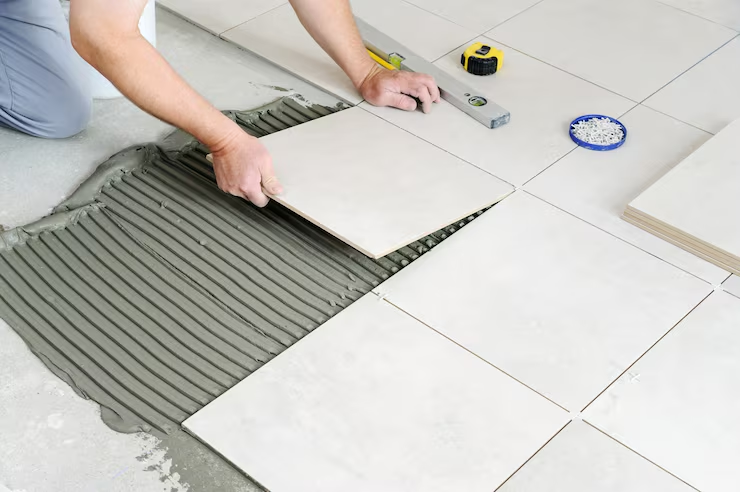
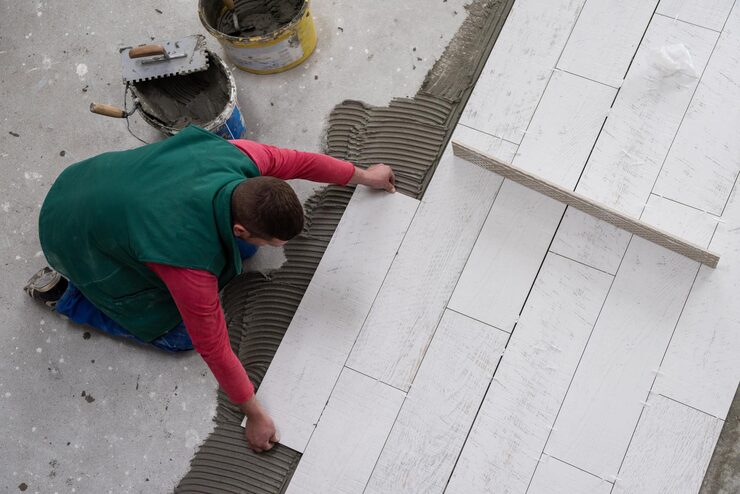
Apply with the correct notched trowel. Spread adhesive on the substrate using a notched trowel. Notch size must match tile size. For tiles up to 30 x 30 cm, a 6 mm square notch is typically appropriate. For tiles from 30 x 60 cm to 60 x 60 cm, use an 8 to 10 mm notch. For tiles larger than 60 x 60 cm, use a 10 to 12 mm notch. Using an undersized notch on large tiles creates hollow spots in the adhesive bed that lead to cracked tiles under load.
Back-butter large tiles. For tiles larger than 60 x 60 cm or for any heavy natural stone tile, apply a thin skim of adhesive to the tile back as well as the substrate. This ensures full contact across the entire tile back and eliminates the air pockets that cause hollow-sounding tiles.
Set tiles within the open time. Place tiles firmly into the adhesive bed with a slight twisting motion to collapse the trowel ridges and ensure full contact. Tap each tile with a rubber mallet and check level with a spirit level. Tile adjustments are possible for up to 10 minutes from placement. After that, the adhesive begins to grip firmly and tiles should not be moved.
Do not allow traffic for 24 hours. The adhesive needs this period for initial set. Walking on freshly set tiles shifts them and creates uneven surfaces and bond failures.
Grout after 24 hours. SB Grip and SB Pro both allow grouting to begin after 24 hours. Do not grout sooner. Full adhesive cure completes within 7 days under normal conditions.
Common Tile Installation Mistakes and How Adhesive Choice Prevents Them
Understanding what goes wrong on tiling jobs, and why, is one of the best ways to avoid the same outcomes.
Tiles becoming hollow within months of installation is almost always caused by insufficient adhesive coverage on the tile back, too-small a trowel notch, or mortar used instead of adhesive on low-porosity tiles. Using a C2TE adhesive with the correct notch trowel and back-buttering large tiles prevents this completely.
Tiles sliding on walls during installation is caused by using an adhesive without the T (slip resistance) designation. Any wall tile, especially above 20 x 20 cm, needs an adhesive with the T classification. Both SB Grip C1T and SB Pro C2TE carry the T designation.
Tiles cracking at edges after installation is typically caused by rigid adhesive or mortar failing to absorb thermal movement in the substrate. Polymer modified adhesive with built-in flexibility prevents this in normal residential and commercial conditions.
Grout joint failure and water entering behind tiles in bathrooms is caused by the absence of a waterproofing layer beneath the tiles. Tile adhesive is not a waterproofing product. It bonds tiles to the substrate. A liquid waterproofing compound must be applied before tiling in all wet areas. SB Hydra Shield Waterproof Anti Leakage Agent is applied to bathroom floors and walls before adhesive and tiles, creating the moisture barrier that protects the substrate and the adhesive layer from water ingress.
For a full review of installation errors that experienced builders have learned to avoid, see common tile installation mistakes builders make and how tile bond prevents them.
How to Estimate Tile Bond Adhesive Quantity for Your Project
Coverage for both SB Grip and SB Pro is approximately 4 to 5 square meters per 20 kg bag, assuming standard notch trowel use. Here is a practical estimation guide.
For a 50 square meter living room floor with 60 x 60 cm tiles, you need approximately 10 to 13 bags. For a 100 square meter commercial floor with large format 60 x 120 cm tiles, you need approximately 20 to 25 bags. For a 10 square meter bathroom floor and walls combined, you need approximately 2 to 3 bags.
Add 10 percent to all estimates for waste, spillage, and areas requiring extra adhesive such as uneven substrates or back-buttering of large tiles.
Both products are packaged in 20 kg moisture-resistant bags with a shelf life of 12 months in unopened original packaging stored in a cool, dry location.
Where to Buy Tile Adhesive in Pakistan
StoneBird Chemicals supplies both SB Grip Tile Bond C1T and SB Pro Tile Bond C2TE through a growing distributor network across Pakistan. Whether you are a contractor sourcing product for a large commercial project or a homeowner planning a bathroom renovation, their team provides product guidance and helps you find the nearest supply point.
Visit the StoneBird Chemicals distribution page for regional distributor information, or contact the technical team directly for project-specific advice on product selection, quantities, and application guidance.
The Short Version of Everything Above
Tile adhesive outperforms traditional mortar in bond strength, flexibility, consistency, and compatibility with modern tile types. The right adhesive grade, C1T for standard residential use and C2TE for large tiles, wet areas, and commercial applications, is the single most important product decision on any tiling project. Applied correctly on a clean, dry, well-prepared surface, quality polymer modified tile adhesive keeps tiles flat, bonded, and problem-free for many years. Applied incorrectly or substituted with an under-specified product, no tile installation stays trouble-free for long.