
Choosing the best tile adhesive for floors in Pakistan is essential for achieving a strong bond, a smooth finish, and long-lasting flooring. Whether you are installing tiles in a home, bathroom, kitchen, office, shopping mall, or commercial building, the adhesive must match the tile material, floor surface, and installation conditions. Pakistan’s hot summers, monsoon moisture, and differences in construction quality make choosing the right product particularly important. Using an unsuitable adhesive can lead to loose tiles, hollow sounds, cracked grout, and expensive repairs. The best option is not always the cheapest bag or the product with the strongest marketing claims. It is the adhesive that meets the technical requirements of your project and is applied correctly. In this guide, we explain which tile adhesive works best for different floor types, what to check before purchasing, and how to compare suitable options from Stonebird Chemicals.
What Is the Best Tile Adhesive for Floors in Pakistan?
The best tile adhesive depends on the tile type, tile size, substrate, and location. Standard ceramic floor tiles on a stable indoor surface may work well with a suitable general-purpose cementitious adhesive. Porcelain tiles, large-format flooring, and demanding commercial installations often require an adhesive with improved bonding performance.
For example, Stonebird Chemicals offers Stone Bond Tile Bond Adhesive for floor and wall applications, while its SB-Pro C2TE adhesive is designed for demanding applications, including large-format tiles and heavy-traffic commercial floors.
Before buying, review the product’s technical data sheet to verify that it is suitable for your specific tile and floor. A product’s advertised strength alone does not prove that it is the right choice for every installation.
Types of Floor Tile Adhesives Available in Pakistan
Understanding the main adhesive categories helps you choose a product that fits your project rather than paying for unnecessary features or selecting a grade that does not meet the requirements.
1. General-Purpose Cementitious Tile Adhesive
General-purpose cement-based tile adhesive is commonly used for residential flooring when the product is approved for the tile and substrate. It is supplied as a powder that is mixed with the specified amount of clean water before application.
This type can be suitable for many standard ceramic tile installations on properly prepared concrete or cement-based surfaces. However, not every general-purpose adhesive is suitable for porcelain, large-format tiles, exterior floors, or areas exposed to demanding conditions.
For ordinary indoor flooring, check the product label and technical documentation before making a decision. You can explore Stonebird Chemicals’ tile adhesive products to compare available solutions.
2. Polymer-Modified Tile Adhesive
Polymer-modified tile adhesive contains additives that improve properties such as adhesion, workability, and, depending on the formulation, flexibility. These characteristics can be useful for modern tile installations where a reliable bond is important.
The actual performance depends on the product formulation and its tested specifications. Do not assume that every polymer-modified adhesive has the same bonding strength or is approved for the same applications.
Stonebird’s Stone Bond Tile Bond Adhesive is described by the manufacturer as a polymer-modified product for ceramic, porcelain, marble, and other tile and stone applications. Confirm the exact tile size, substrate, and installation conditions with the manufacturer’s technical guidance before use.
3. High-Performance C2TE Tile Adhesive
For large-format porcelain tiles, certain natural stones, tile-over-tile renovation, and demanding commercial applications, a higher-performance adhesive may be required. One classification worth understanding is C2TE.
Under the EN 12004 classification system, C refers to cementitious adhesive, 2 indicates improved adhesion, T indicates reduced slip, and E indicates extended open time. The classification describes performance characteristics; it does not mean every C2TE product is automatically suitable for every floor.
Stonebird’s SB-Pro C2TE is marketed for large-format tiles, commercial floors, and other demanding applications. Check its current technical data sheet and confirm that its requirements match your project.
For a broader explanation of adhesive classes, read Stonebird’s guide on how to choose tile adhesive in Pakistan.
Expert Recommendations: Which Tile Adhesive Should You Use?
The following recommendations are a practical starting point. The final selection should always follow the adhesive manufacturer’s specifications and the requirements of the complete flooring system.
Best for Standard Ceramic Floor Tiles
For standard ceramic tiles installed indoors on a sound, level cement-based surface, choose a good-quality cementitious adhesive that explicitly lists ceramic floor tiles among its approved applications.
You may not need the most expensive high-performance grade for a simple residential project. However, selecting an adhesive solely by price can be a mistake if the product does not meet the installation requirements.
Before purchasing, check the tile dimensions, substrate compatibility, coverage guidance, and curing time. Stonebird’s Tile Bond product page is one option to review for this type of project.
Best for Porcelain and Vitrified Floor Tiles
Porcelain tiles are dense and typically have very low water absorption. This means the adhesive must provide suitable bonding performance without relying on the tile absorbing significant moisture.
For porcelain and vitrified tiles, choose a product that specifically approves these materials. A higher-performance polymer-modified adhesive may be required, especially for larger tiles or demanding installation environments.
LATICRETE explains the bonding considerations for porcelain in its thinset and tile adhesive FAQs. Use this as additional guidance, then verify the requirements of the product available for your project in Pakistan.
Best for Large-Format Floor Tiles
Large-format tiles, such as 600 × 600 mm tiles and larger formats, require particular attention to floor flatness and adhesive coverage. An unsuitable adhesive or poor installation technique can leave unsupported areas beneath the tiles.
For these installations, consider a product specifically designed for large-format tiles and confirm whether improved adhesion, extended open time, or deformability is required.
Stonebird’s SB-Pro C2TE adhesive is one product to evaluate for demanding large-format installations. Its technical suitability should be checked against the tile manufacturer’s instructions and the site conditions.
MAPEI’s ceramic tile and stone adhesive selection chart is another useful reference for understanding why adhesive selection depends on tile type, substrate, and service conditions.
Best for Bathroom and Kitchen Floors
Bathroom and kitchen floors may be exposed to water, cleaning products, and regular moisture. Choose an adhesive approved for the intended wet-area application and make sure the complete installation includes any required waterproofing system.
Tile adhesive and waterproofing are not the same thing. Even an adhesive with water-resistant properties does not automatically make a bathroom floor waterproof.
For wet areas, confirm compatibility among the substrate, waterproofing membrane, adhesive, grout, and tile. Explore Stonebird Chemicals for its construction chemical products and seek technical advice if your project requires a waterproofing system.
Best for Commercial Floors With Heavy Foot Traffic
Shopping malls, offices, restaurants, and other busy commercial spaces may place greater demands on a tiled floor than a typical residential room. In these settings, adhesive selection must account for the tile, substrate, expected loading, and service conditions.
A higher-performance product may be appropriate, but adhesive strength alone cannot compensate for weak concrete, poor surface preparation, inadequate coverage, or missing movement joints.
Stonebird’s SB-Pro C2TE is marketed for heavy-traffic commercial flooring. Before specifying it for a project, have the product documentation reviewed against the expected use and installation design.
What to Check Before Buying Floor Tile Adhesive
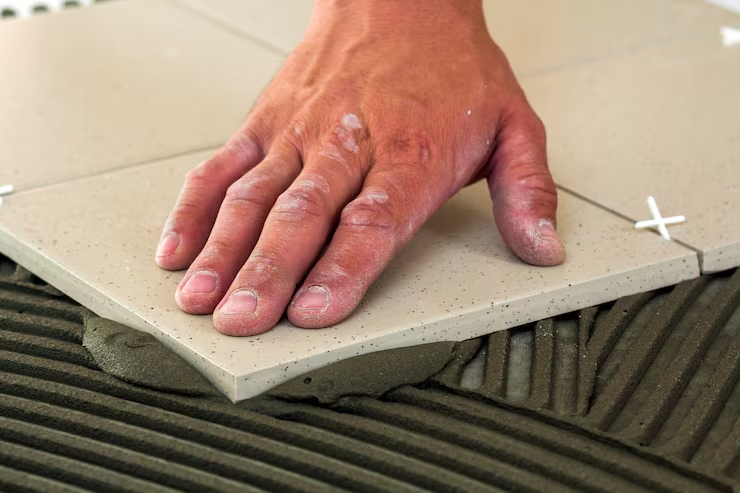
Choosing a suitable product involves more than comparing brands. Review these important factors before purchasing.
Tile Material and Dimensions
Identify whether you are installing ceramic, porcelain, vitrified tiles, marble, granite, or another material. Tile size also matters because large tiles may require a different adhesive and installation method from small tiles.
For natural stone, confirm that the adhesive is specifically suitable for the stone type. Light-coloured marble may require a white adhesive to reduce the risk of visible discolouration.
Floor Surface and Preparation
The floor must be stable, clean, and sufficiently flat. Dust, oil, weak cement, loose material, and other contaminants can interfere with bonding.
An adhesive should not be used to compensate for major floor unevenness unless the product is specifically designed and approved for that application. Use an appropriate levelling or repair system where necessary.
Indoor or Outdoor Installation
An indoor floor and an exposed outdoor floor experience different conditions. Exterior surfaces may face rain, temperature changes, and greater movement. Choose a product specifically approved for the intended environment.
Open Time and Pot Life
Open time is the period during which applied adhesive can still bond properly with the tile. Pot life refers to how long mixed adhesive remains usable in the container.
These times are not identical. Hot weather, wind, and direct sunlight can affect installation conditions, so prepare manageable quantities and follow the manufacturer’s instructions.
Technical Data and Test Standards
Check the product’s technical data sheet for its approved uses, adhesion classification, mixing ratio, bed thickness, coverage guidance, and curing requirements. Where a product claims compliance with a standard, look for the relevant documentation rather than relying only on advertising.
The Ceramic Tile Education Foundation’s tile installation resources offer further information about proper tile installation practices.
How Much Tile Adhesive Do You Need for a Floor?
The quantity depends on the floor area, tile dimensions, substrate flatness, trowel size, and required adhesive coverage. A larger tile may require a different trowel and installation method, which can affect consumption.
As an initial estimate, calculate the floor area in square metres and compare it with the coverage stated on the product packaging or technical data sheet. For example, if a product covers approximately 4–5 m² per 20 kg bag under the stated conditions, a 20 m² floor would theoretically require around four to five bags before allowing for wastage or variations in site conditions.
This is only an example, not a guaranteed coverage rate for every adhesive or tile. Use the actual product’s coverage guidance, and allow for the condition of the floor and the installer’s technique.
You can contact Stonebird Chemicals for product-specific coverage guidance and help estimating the quantity needed for your project.
Common Mistakes to Avoid When Installing Floor Tiles
Even a suitable adhesive can fail when it is used incorrectly. Avoid these common mistakes:
- Applying adhesive over dusty, oily, weak, or unstable surfaces.
- Adding too much water or ignoring the specified mixing ratio.
- Spreading adhesive over an area that cannot be tiled within the open time.
- Using a product that is not approved for porcelain or large-format tiles.
- Leaving significant gaps beneath tiles because of inadequate adhesive coverage.
- Using tile adhesive to correct major floor unevenness without checking product suitability.
- Walking on the floor or grouting before the adhesive has cured sufficiently.
- Ignoring movement joints or structural cracks in the substrate.
For demanding projects, follow the tile and adhesive manufacturers’ instructions and use a qualified installer when necessary. MAPEI’s tile-over-tile installation guide also illustrates why preparation and compatible installation materials are important when tiling over existing surfaces.
Why Consider Stonebird Chemicals for Tile Adhesive in Pakistan?
Stonebird Chemicals is a Pakistan-based construction chemicals manufacturer offering tile adhesives and other products for building projects. Its product range includes Stone Bond Tile Bond Adhesive, SB-Pro C2TE, and Stonebond White.
Each product is intended for particular applications, so the best choice depends on the installation rather than the brand name alone. Stone Bond Tile Bond is an option to investigate for suitable general floor and wall applications. SB-Pro C2TE is positioned for more demanding work, including large-format tiles and commercial flooring. Stonebond White may be appropriate where a white formulation is beneficial for light-coloured tiles or stone.
Before selecting any product, review the current technical data sheet and confirm that it is suitable for the tile material, floor surface, and intended environment. You can visit the Stonebird Chemicals website or its products page to explore the available range and request further guidance.
Frequently Asked Questions
Which tile adhesive is best for floors in Pakistan?
The best adhesive depends on the tile material, tile size, floor surface, and installation conditions. A suitable general-purpose adhesive may be sufficient for standard ceramic tiles on an indoor floor, while porcelain, large-format tiles, and demanding commercial installations may require a higher-performance product. Check the manufacturer’s technical data sheet rather than selecting by price alone. In Pakistan, you can compare options such as Stonebird’s Tile Bond and SB-Pro C2TE according to your project’s requirements.
Can I use the same tile adhesive for ceramic and porcelain floors?
Only if the adhesive manufacturer explicitly approves it for both tile types. Porcelain absorbs very little water, so it often requires an adhesive with suitable bonding performance for dense, low-absorption surfaces. Some products are designed for both ceramic and porcelain, but not every general-purpose adhesive is suitable. Always check the approved applications, tile size limits, and installation conditions before buying. If you are unsure, consult the product manufacturer or a qualified tiling professional.
Is C2TE tile adhesive better for floor tiles?
C2TE indicates a cementitious adhesive with improved adhesion, reduced slip, and extended open time under the relevant classification system. Those properties can be useful in demanding installations, but C2TE is not automatically the best choice for every floor. A simple indoor ceramic floor may not require the same performance as a large-format porcelain floor or a busy commercial space. Select the grade according to the tile, substrate, environmental conditions, and technical specifications.
How many bags of tile adhesive are needed for 100 square feet?
The answer depends on the product’s stated coverage, tile dimensions, trowel size, substrate condition, and installation method. Convert the floor area to square metres—100 square feet is approximately 9.29 m²—then divide the area by the coverage stated for one bag. For example, if a 20 kg bag covers 4–5 m² under the stated conditions, the calculation suggests approximately two to three bags before allowing for wastage. Confirm the actual coverage on the product’s technical data sheet.
Can tile adhesive be used for bathroom floors?
Yes, if the product is approved for the intended bathroom floor application and is compatible with the tile and substrate. However, adhesive is not a replacement for a waterproofing membrane where waterproofing is required. Proper surface preparation, waterproofing details, grout selection, and curing all contribute to the durability of a bathroom floor. Follow the complete installation system’s instructions and confirm compatibility between the adhesive and waterproofing products.
Final Thoughts
The best tile adhesive for floors in Pakistan is the product that matches your tile material, floor surface, and installation conditions. Standard ceramic flooring may need a different solution from large-format porcelain, wet-area flooring, or commercial installations exposed to heavy traffic.
Before purchasing, check the product classification, approved applications, coverage guidance, and technical data sheet. Correct surface preparation, sufficient adhesive coverage, and proper curing are just as important as choosing the right bag.
To compare available options, explore Stonebird Chemicals’ tile adhesive range, review Stone Bond Tile Bond Adhesive, and consider SB-Pro C2TE for applications that require higher performance. Confirm the final selection with the manufacturer or a qualified installer before beginning your project.