
Walk into any new construction project in Pakistan today and you will see large format tiles everywhere. Sixty by sixty centimeters on floors. Sixty by one-twenty on lobby walls. Full-length porcelain panels on building facades. Large marble slabs in bathrooms and living areas. What was once only seen in five-star hotels and upscale commercial projects is now standard across mid-range residential construction in every major city.
The tiles look outstanding when done correctly. When done incorrectly, they fail in ways that smaller tiles never do. They crack in the center. They hollow out along edges. They slide off walls during installation. They debond from floors within a season. And because each tile is large and expensive, a single failed installation job can cost more to fix than the contractor earned on the project.
This guide is for contractors, tilers, and builders who work with large format tiles in Pakistan. It covers every stage: surface preparation, adhesive selection, mixing, application, leveling, and the common mistakes that turn a premium job into a callback.
Table of Contents
What Qualifies as a Large Tile
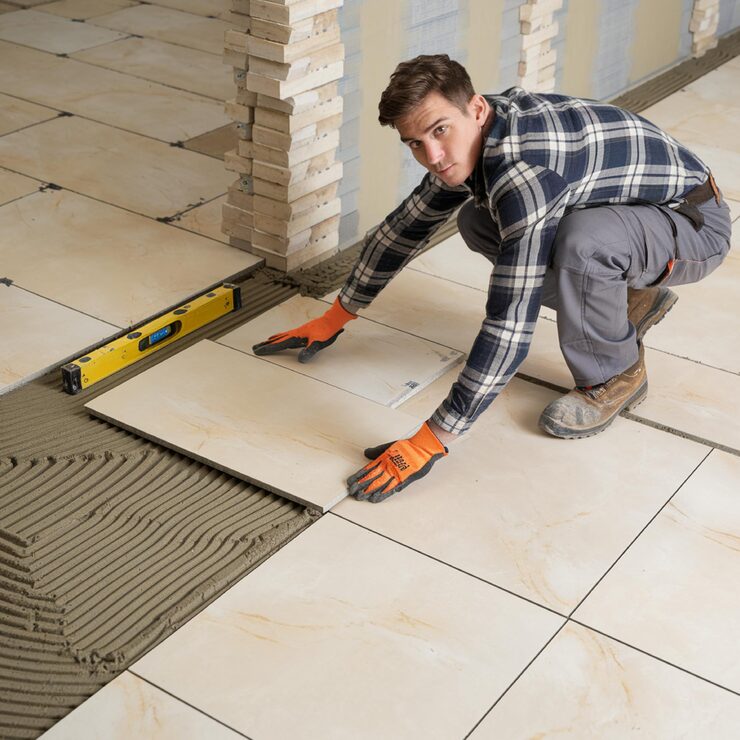
In the Pakistani market and under international installation standards, a large format tile is any tile with at least one edge measuring 60 centimeters (approximately 24 inches) or more. Common large format tile sizes used in Pakistan today include 60 x 60 cm, 60 x 120 cm, 80 x 80 cm, 90 x 90 cm, and full-panel porcelain slabs up to 120 x 240 cm for exterior cladding.
The Tile Council of North America defines tiles above 15 inches on any single edge as large format for installation specification purposes. Their guidelines mandate polymer-modified adhesives and full-bed coverage for all large format tile installations, regardless of the tile material. Pakistan’s construction industry is increasingly aligning with these international benchmarks as building specifications on institutional and Grade-A commercial projects become more demanding.
Understanding why large tiles fail differently from small tiles begins with basic physics: the larger the tile, the heavier it is, the greater the surface area that must be supported by adhesive, and the more movement it experiences as a single rigid unit when temperature changes cause the floor or wall behind it to expand and contract.
Why Large Tiles Fail Differently
A 30 x 30 cm ceramic tile weighs approximately 2.5 kg. A 60 x 120 cm porcelain slab weighs 15 to 20 kg depending on thickness. A 120 x 240 cm panel can exceed 60 kg per piece.
That weight difference changes everything about how the tile behaves on the wall or floor.
Gravity is a serious force on wall tiles. A small wall tile stays in place because the adhesive’s initial grip is strong relative to the tile’s weight. A heavy large format wall tile requires an adhesive with measurably higher slip resistance. Without it, the tile slides down the wall in the minutes between placement and adhesive set. Even a millimeter of movement ruins joint alignment across an entire wall run.
Thermal movement is amplified across a larger surface. When temperature changes, tiles and slabs expand and contract. A 30 x 30 cm tile expands a small amount across its surface. A 60 x 120 cm tile expands across four times the area, generating four times the movement stress at its edges and corners. An adhesive without adequate flexibility cracks at these stress points.
Hollow spots under large tiles cause failure under load. A small tile with one hollow spot can survive for years because the hollow area is a small fraction of the tile’s total surface. The same hollow spot under a large tile, where unsupported areas carry disproportionate loads, becomes the crack initiation point when any significant weight is placed above it.
Porcelain’s low porosity means cement mortar does not bond to it. This is the most critical technical fact in large format tile installation. Porcelain tiles are fired at temperatures above 1,200 degrees Celsius. The resulting material has water absorption below 0.5 percent. Plain cement mortar depends partly on moisture exchange with the tile back during curing to form its bond. Porcelain absorbs almost no moisture, so the mortar has almost nothing to grip. The bond formed is weak and fails early.
These are the reasons large format tile installation requires a specifically engineered approach that is different from standard tile work.
Choosing the Right Adhesive for Large Tiles
The adhesive classification system under European standard EN 12004, now widely referenced on construction projects in Pakistan, gives contractors a clear framework for matching adhesive grade to tile type and location.
For large format tiles in Pakistan, the minimum required grade is C2TE.
C confirms the adhesive is cementitious. 2 means improved performance, with a minimum pull-off adhesion of 1.0 N/mm² that is maintained after heat aging, water immersion, and freeze-thaw testing. T means reduced slip, the property that prevents heavy wall tiles from sliding during installation. E means extended open time of at least 30 minutes, giving tilers enough time to position, level, and adjust large heavy tiles before the adhesive grips.
A C1 adhesive, which meets only baseline performance requirements, is not appropriate for large format tiles. Its bond strength is insufficient for the weight involved, it has no guaranteed slip resistance for wall applications, and its open time may not accommodate the precise placement large tiles require.
SB Pro Tile Bond C2TE by StoneBird Chemicals is engineered specifically for large format tiles and demanding commercial and architectural applications in Pakistan. It is tested against ASTM D7234 for pull-off adhesion, EN 12004 for C2TE classification compliance, and AASHTO T 193 for shear resistance. Its 30-minute-plus open time and 3 to 4-hour pot life give professional tilers the working window that large format installation demands.
For standard residential tiling with tiles up to 30 x 30 cm, SB Grip Tile Bond C1T delivers verified pull-off adhesion of 1.12 N/mm², compressive strength of 1,534 psi, and shear strength of 1,067 psi, making it the right specification for normal residential floors and walls. The choice between C1T and C2TE depends not on preference but on tile size and application demand.
For a full technical explanation of why large tiles demand C2TE, see our guide on why large format tiles need a stronger tile adhesive in Pakistan.
Substrate Preparation for Large Tile Installation
No adhesive, regardless of its quality, compensates for a poorly prepared substrate. On large format tile jobs, surface preparation is more critical than on standard installations because the larger tile surface area magnifies any irregularity.
Flatness tolerance. The international standard for large format tile installation specifies a maximum floor deviation of 3 mm under a 3-meter straightedge for tiles up to 60 cm, and 2 mm under a 3-meter straightedge for tiles above 60 cm. In practice, Pakistani construction often produces floors with variations well beyond this. Before tiling begins, the entire floor must be assessed with a long spirit level or straightedge, and any highs ground down and any lows filled with a cementitious floor leveling compound and allowed to cure.
Structural soundness. Tap the substrate with a hammer across the full area. Any hollow sound indicates a debonded screed or weak concrete that must be repaired before tiling. A large heavy tile placed over a weak substrate will crack as the substrate deforms under load.
Surface cleanliness. The substrate must be free of all dust, oil, curing compounds, paint, and loose material. Any contamination between the adhesive and the substrate creates a weak interface. Sweep, vacuum, and if necessary damp-mop the surface. Allow it to dry completely before adhesive application.
Moisture content. Fresh screeds must be tested for moisture before tiling. A new cement screed typically requires 28 days to cure before large format tiles are laid. Tiling over an incompletely cured screed traps moisture, causes adhesive failure, and can stain light-colored marble or porcelain from beneath. Use a moisture meter and confirm readings are within acceptable limits before proceeding.
Priming. On highly porous substrates such as rough concrete or dry screed, a diluted application of the adhesive itself or a compatible primer prevents the substrate from pulling moisture out of the adhesive too quickly. This is particularly important in summer when hot dry substrates can accelerate adhesive drying and reduce open time.
Mixing Large Tile Adhesive Correctly
Adhesive mixing is a step where shortcuts have direct consequences on bond quality. Follow this process for every batch.
Pour clean water into the mixing bucket first. Add the correct water volume for the bag size: approximately 5 to 6 liters per 20 kg bag of SB Pro C2TE. Add the powder gradually while mixing with a low-speed drill mixer fitted with a paddle attachment. Mix continuously until the paste is completely smooth with no lumps or dry pockets. Allow the mix to rest for 5 minutes. This rest period lets the polymer and cement components fully activate. Mix again briefly before use.
Do not add extra water to a batch that has already begun to set. Once a batch begins stiffening in the bucket, mix a fresh batch. Adding water to an already-setting batch breaks down the polymer network and produces a final bond significantly weaker than the product specification.
Do not mix too much adhesive at once. On a hot day in Pakistan, even a 4-hour pot life can be shortened by ambient heat. Mix quantities you can use within 2 hours during summer, and confirm the batch consistency before spreading each section.
Step by Step: Large Floor Tile Installation
Step 1: Set out the layout. Before spreading a single bit of adhesive, dry-lay the first row of tiles across the room to verify the layout. Large tiles amplify any layout error. A misalignment that would be barely visible with small tiles becomes immediately obvious across a 60 x 120 cm slab. Find the center of the room or the most visible sightline from the main entrance and work outward from there.
Step 2: Apply adhesive to the substrate. Spread adhesive using a notched trowel sized to the tile. For 60 x 60 cm tiles, use a 10 mm square notch trowel. For 60 x 120 cm tiles, use a 12 mm notch. Work in sections of no more than 1 square meter at a time. Comb the adhesive in parallel lines in one consistent direction. This alignment of ridges helps you see how well the tile has collapsed the adhesive when you lift a tile to check coverage.
Step 3: Back-butter every tile. Apply a thin, flat combing of adhesive to the back of each tile using a straight edge trowel. For porcelain tiles, which have near-zero water absorption, this is essential. For marble, it fills the natural surface irregularities of the stone. For any tile above 60 cm, it ensures full contact between the tile and the adhesive bed regardless of minor surface variation in either the substrate or the tile.
Step 4: Place the tile. Lower the tile into position carefully, especially for very large slabs. Two-person placement is necessary for tiles above 90 x 90 cm. Slide the tile slightly as you press it down, a 2 to 3 cm backward slide and return, to collapse the adhesive ridges and ensure contact. Do not drop the tile into position from above. Dropping creates air pockets and disrupts the adhesive bed.
Step 5: Tap with a rubber mallet across the full surface. Use a rubber mallet, not a hammer, and tap methodically across the entire tile surface from edge to edge. This drives any remaining air out from under the tile and ensures the adhesive ridges fully collapse for complete coverage. Use a beater board, a piece of timber or specialized rubber pad, to protect the tile surface and distribute force evenly.
Step 6: Check level immediately. Use a spirit level after placing every tile. Large tiles must be level with each other and with a consistent slope where drainage is required. Adjust within the open time window. Once the adhesive begins to grip, do not attempt to shift the tile. Lift it completely, spread fresh adhesive, and reset.
Step 7: Use a tile leveling system. For large format tiles on floors and walls, a mechanical leveling system using clips and wedges is the professional standard. The clips are placed under tile edges before setting, and wedges are tapped in to draw adjacent tiles to the same height. This eliminates the lippage, the step between adjacent tiles, that ruins the appearance of a large format floor and creates a trip hazard. Once the adhesive sets, the clip tabs are snapped off flush.
Step 8: Check adhesive coverage by lifting a tile. After setting the first three or four tiles, lift one to check the adhesive coverage on its back. You should see adhesive coverage across at least 85 percent of the tile back, with contact distributed evenly including at the corners and edges. If coverage is less than this, the trowel notch is too small, the tile needs back-buttering, or the adhesive was applied too long ago and has begun to skin over. Adjust before continuing.
Step 9: Allow 24 hours before grouting. Do not allow foot traffic on the newly laid floor for 24 hours. Do not grout before this period. Full adhesive cure takes 7 days. Avoid heavy equipment or loads on the new floor during this period.
Large Tiles on Walls: Additional Considerations
Wall installation of large format tiles is technically more demanding than floor installation because gravity works against you throughout the entire process.
The slip resistance of the adhesive is the critical property for wall work. The T designation in C2TE confirms the adhesive resists tile sliding during the period between placement and initial set. Without this, large heavy wall tiles slide downward, ruining alignment and requiring physical propping.
Apply adhesive to the wall in small sections of no more than 0.75 square meters at a time. Work from the bottom up. Place each tile firmly and immediately. On smooth tile-back surfaces, use suction cup handles to control placement precisely and reduce the physical effort of holding large slabs against the wall while positioning them.
Vertical joints must be supported with wedge spacers or tile leveling clips to prevent tiles from dropping before the adhesive grips. Remove all spacers and wedge supports before the adhesive fully cures so they do not become locked in place.
For exterior wall cladding with large format porcelain panels, mechanical fixing systems are required in addition to adhesive for any panel above 1.5 meters height. The adhesive alone should not be the only means of support for large elevated exterior panels. This is a safety consideration that applies to building facades in Pakistan where panels over passenger walkways or public areas require positive mechanical fixing.
Movement Joints: The Step Most Contractors Skip
Movement joints, also called expansion joints, are gaps left in a tile installation that are filled with flexible sealant rather than grout. They allow the tile field to expand and contract with temperature without building up stress that cracks tiles or debonds adhesive.
The British Standards Institution BS 5385 and international tile installation guidelines specify movement joints at maximum 4.5 meter intervals in floors and at all perimeters, columns, and changes of direction.
In Pakistan, movement joints are almost universally skipped on residential projects and frequently skipped on commercial ones. The result is that large format tile floors develop cracks, particularly at corners and around columns, within two to three years of installation as accumulated thermal stress finds its weakest point.
For large format tile installations, movement joints are not optional. They should be left at all perimeter walls, at all structural columns, and across the floor field at intervals appropriate to the tile size. Fill these joints with a matching colored flexible silicone sealant, not grout. Grouted movement joints defeat their entire purpose.
Common Large Tile Installation Mistakes in Pakistan
Using plain cement mortar on porcelain. The most common failure on Pakistani sites. Mortar does not bond to low-porosity porcelain. The tile seems to be fixed but the bond is mechanical only, relying on the mortar wrapping the tile edge rather than bonding to its face. It fails within the first year.
Using an undersized notch trowel. A 6 mm notch on a 60 x 120 cm tile leaves most of the tile back unsupported after compression. Always match trowel notch size to tile size.
Skipping back-buttering. For large format tiles, back-buttering is not an optional technique. It is the only reliable way to ensure full contact across the full back surface of a heavy tile.
Not checking adhesive coverage. Lift a tile early and look at the coverage. This simple check prevents an entire floor of poorly bonded tiles from going down before anyone discovers the problem.
Skipping movement joints. Pakistani floors without movement joints develop cracks. Large format tiles without movement joints develop cracks faster and more dramatically.
Rushing the layout. Setting out large format tiles without a dry run first almost always produces a layout that reaches a wall with a very thin cut tile on one side and a full tile on the other, or with joints that misalign with architectural features. Invest the time in layout planning before adhesive is spread.
For a broader look at installation errors and their causes, see our guide on common tile installation mistakes builders make and how tile bond prevents them.
Waterproofing Before Tiling in Wet Areas
In bathrooms, wet rooms, laundry areas, and balconies, a waterproofing layer must be applied to the substrate before any tile adhesive is used. This applies regardless of tile size.
The waterproofing creates a moisture barrier that protects the adhesive layer from the water that inevitably passes through grout joints over years of use. Without it, water accumulates behind tiles, weakens the adhesive bond from underneath, and causes the tile failures that make bathroom reworks one of the most common jobs in Pakistani renovation work.
Apply SB Hydra Shield Waterproof Anti Leakage Agent to the bare floor and wall substrate, allow it to cure fully, and then apply SB Pro C2TE adhesive over the cured waterproofing coat before setting tiles. This sequence gives the installation a complete protection system where each layer does its specific job.
Estimating Materials for a Large Tile Project
Coverage for SB Pro Tile Bond C2TE is approximately 4 to 5 square meters per 20 kg bag under standard application conditions. For large format tiles with back-buttering applied to both the substrate and the tile back, plan for 3 to 3.5 square meters per bag because adhesive is used on both surfaces.
For a 100 square meter commercial floor with 60 x 120 cm porcelain tiles using back-buttering, you need approximately 28 to 33 bags. Add 10 to 15 percent to all estimates for waste and edges.
For waterproofing in wet areas before tiling, SB Hydra Shield covers approximately 100 square feet (approximately 9.3 square meters) per kilogram per coat. A 50 square meter bathroom floor and lower wall area needs approximately 10 to 12 kg for two coats.
To find SB Pro Tile Bond C2TE and SB Hydra Shield near your project location, visit the StoneBird Chemicals distribution page for regional coverage information.
The Professionalism Gap in Large Tile Work
Large format tiles demand more skill, more preparation, and better materials than any other standard tile type. The gap between a correctly installed large format tile floor and a poorly installed one is visible within months on a Pakistani project, where heat, moisture, and building movement test every joint and every adhesive bond continuously.
Contractors who invest in the right product, follow the correct technique, and build the extra preparation steps into their project pricing deliver floors that last. Contractors who cut costs on adhesive grade, skip back-buttering, and rush through substrate preparation deliver callbacks.
For the best results on large format tile projects in Pakistan, pair proper installation technique with SB Pro Tile Bond C2TE, a C2TE-classified adhesive manufactured and tested specifically for Pakistan’s demanding construction environment. For additional technical guidance on product selection and quantities for your specific project, contact the StoneBird Chemicals team directly.