
Commercial Floor and Elevation tiling in Pakistan, Commercial tiling is a different discipline from residential work. The scale is bigger, the stakes are higher, the loads are heavier, and the consequences of failure go far beyond a homeowner’s inconvenience. A floor that fails in a shopping plaza stops business. A wall tile that falls from a building elevation above a public walkway is a safety emergency. A hotel lobby with hollow tiles discovered six months after handover is a legal problem for the contractor.
Pakistan’s commercial construction sector has grown rapidly over the past decade. Grade-A office buildings, shopping malls, hospitals, hotels, universities, and mixed-use developments are being built across Lahore, Karachi, Islamabad, Faisalabad, and Multan at a pace not seen before. Tile quality has improved. Tile sizes have increased. Client expectations have risen.
What has not always kept pace is the technical understanding of what commercial and elevation tiling actually requires from the builder, the materials, and the process.
This guide covers everything that matters: substrate standards, adhesive selection, application techniques for floors and facades, movement joint requirements, and the quality checks that separate a professional commercial tiling job from one that generates callbacks.
Table of Contents
How Commercial Tiling Differs from Residential Work
The differences between residential and commercial tiling are not cosmetic. They are structural and practical.
Load intensity is higher. A residential living room floor carries the weight of furniture and a small number of people. A commercial lobby carries hundreds or thousands of visitors daily, cleaning machines, delivery equipment, and in some cases vehicles in covered commercial areas. Every tile and every adhesive joint is loaded repeatedly every single day.
Tile sizes are larger. Modern commercial aesthetics favor large format tiles that create seamless, impressive floor planes. Sixty by sixty centimeters is now considered a minimum for most Grade-A commercial floors. Sixty by one-twenty and larger are common. Large tiles demand more adhesive coverage, more precise leveling, and significantly more technical skill than standard residential tiles.
Failure is more visible and more costly. In a house, a cracked or hollow tile is noticed by the homeowner and eventually fixed. In a commercial space, every defect is seen by dozens or hundreds of people every day. Callbacks on commercial projects damage contractor reputations, trigger contractual penalties, and in serious cases lead to litigation.
External elevations carry safety obligations. A wall tile that falls from an external facade can cause serious injury. In Pakistan’s legal environment, contractors who install exterior wall tiles without meeting basic specification requirements face both civil and professional consequences if a failure causes harm.
Understanding these differences is the starting point for approaching commercial and elevation tiling with the discipline it requires.
Adhesive Specifications for Commercial Tiling in Pakistan
The single most important product decision on any commercial tiling project is the adhesive grade. In Pakistan’s construction market, many contractors use whatever adhesive is cheapest or most familiar, regardless of whether it meets the requirements of the application. This is the root cause of most commercial tiling failures.
The European standard EN 12004, which classifies cementitious tile adhesives by performance, provides a clear framework that is now referenced in construction specifications on institutional and Grade-A commercial projects in Pakistan.
For commercial floors and external elevations, the minimum appropriate classification is C2TE.
C2 means improved performance: a minimum pull-off adhesion of 1.0 N/mm² maintained after heat aging, water immersion, and freeze-thaw testing. The 2 classification tells you the adhesive has been tested under conditions that simulate the stresses a commercial tile installation actually faces, not just ideal laboratory conditions.
T means reduced slip: the adhesive resists tile movement after placement. For large heavy wall tiles on building elevations or lobby feature walls, slip resistance is the property that keeps tiles exactly where they were placed while the adhesive sets.
E means extended open time of 30 minutes or more: the adhesive remains fully active long enough for a professional tiler to properly position large tiles on a commercial floor or elevation.
A standard C1 adhesive, which meets only baseline performance requirements, is not appropriate for commercial floors under heavy traffic, for external elevations, or for large format tiles in any location.
SB Grip Tile Bond C1T by StoneBird Chemicals is the right product for standard residential applications, including ceramic and standard porcelain tiles on interior floors and walls. It achieves laboratory-verified pull-off adhesion of 1.12 N/mm², compressive strength of 1,534 psi, and shear strength of 1,067 psi. For standard residential tiling, this performance is excellent.
For demanding commercial floors, large format tiles, exterior elevations, and wet commercial areas, the upgraded specification is SB Pro Tile Bond C2TE, which delivers improved bond strength, superior slip resistance for wall and elevation work, and the extended open time that large-scale commercial installation requires.
Commercial Floor Substrate: What It Must Meet Before Tiling Begins
The substrate is the foundation of every tile installation. On commercial projects, the time invested in getting the substrate right before tiling begins is the single most important factor in the long-term performance of the floor.
Flatness. Commercial floors with large format tiles require a flat substrate within 3 mm deviation under a 3-meter straightedge. This is tighter than residential tolerance because large tiles amplify any irregularity. A floor that varies 5 to 8 mm across a few meters looks level under small tiles and looks completely unacceptable under large format slabs. Assess the entire floor area with a long straightedge before any adhesive is applied. High spots must be mechanically ground down. Low spots must be filled with a cementitious floor leveling compound and allowed to fully cure.
Structural soundness. Tap the substrate across the full area with a hammer or chain. Any hollow sound indicates a debonded screed or weak surface that must be repaired. A heavy commercial tile placed over a weak substrate will crack as the substrate deforms under point loads from foot traffic or equipment.
Cleanliness. The substrate must be free of all dust, oil, curing compounds, paint, and any other contamination. Construction dust on a commercial slab is usually substantial. Vacuum the entire area, then sweep, then vacuum again. If curing compound was applied to the slab after casting, it must be mechanically ground off because tile adhesive will not bond through it.
Moisture content. On commercial projects where time pressure is constant, tiling often begins before concrete or screed has reached adequate dryness. Fresh concrete should cure for a minimum of 28 days. Fresh screed should cure for at least 7 days, and longer for thicker screeds. Tiling over insufficiently dried substrates traps moisture that softens adhesive bonds from below and can cause efflorescence staining on light-colored porcelain or marble tiles. Use a moisture meter and record readings before starting.
Priming. Highly porous or dusty substrates on commercial sites should receive a compatible primer coat before tile adhesive is applied. Primer seals the surface porosity and prevents the substrate from pulling moisture out of the adhesive faster than the adhesive can set. On very smooth, low-porosity concrete surfaces, a light mechanical scarifying improves adhesive adhesion.
Commercial Floor Tiling: Application Process
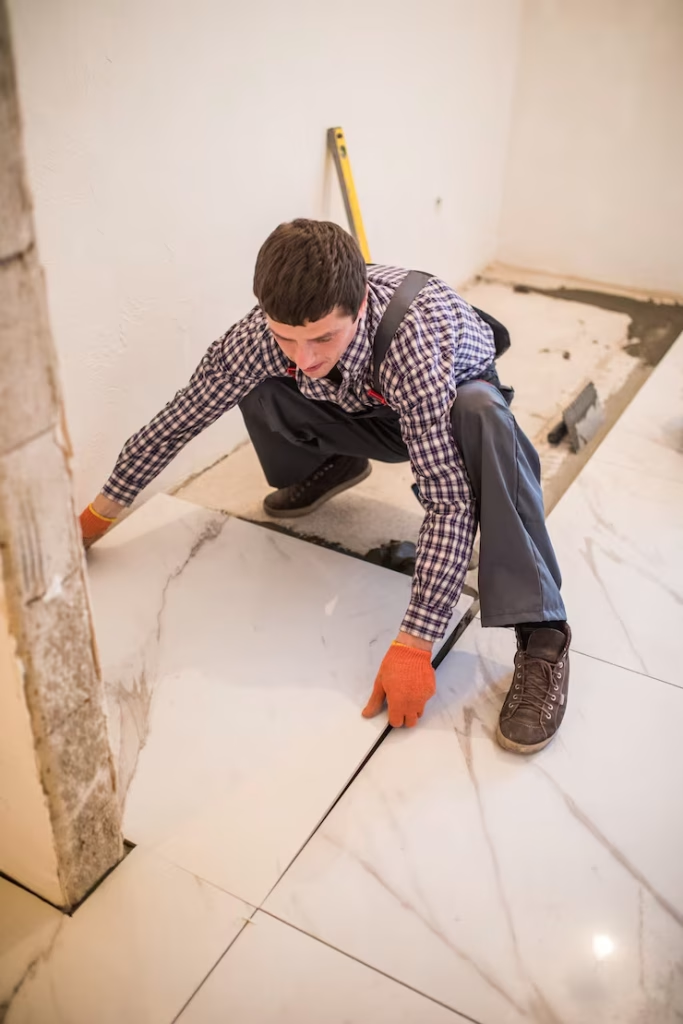
The application process for commercial floors follows the same principles as residential work but with tighter tolerances and stricter quality checks at every stage.
Lay out the tile pattern before spreading adhesive. On a large commercial floor, poor layout planning produces cuts at the wrong location, patterns that misalign with architectural features, and starting points that result in very thin cut tiles at the most visible walls. Snap chalk lines across the floor to establish the layout grid before mixing adhesive. Dry-lay a section to verify the outcome before committing to adhesive.
Mix adhesive in correct batches. For SB Pro C2TE, mix 5 to 6 liters of clean water per 20 kg bag using a low-speed paddle mixer. Mix until completely smooth. Rest 5 minutes. Remix briefly. On a large commercial floor with many workers, establish a mixing station that supplies fresh batches continuously. Do not allow any batch to exceed its pot life of 3 to 4 hours.
Apply with the correct notched trowel for the tile size. For tiles up to 60 x 60 cm, use a 10 mm square notch trowel. For tiles between 60 x 60 cm and 60 x 120 cm, use a 12 mm square notch. Work in sections of no more than 1 square meter at a time on a commercial floor to ensure no adhesive skins over before tiles are placed.
Back-butter all large format tiles. On commercial floors using tiles above 60 cm in any dimension, apply a thin combing of adhesive to the tile back with a flat-edge trowel before pressing onto the floor adhesive. This ensures full contact across the entire tile back, eliminating hollow spots that crack under commercial loading.
Use a mechanical tile leveling system. On commercial grade-A floors, mechanical leveling clips and wedges are the professional standard for eliminating lippage between adjacent tiles. Lippage, the step at tile edges, is a trip hazard in commercial spaces and completely unacceptable on finished commercial floors. Place clips before setting each tile, insert wedges after pressing, and remove both after the adhesive has set sufficiently.
Check adhesive coverage by lifting a tile. At the beginning of each installation session, lift one fully pressed tile and inspect the adhesive contact on its back. You should see adhesive coverage across a minimum of 85 percent of the back surface, distributed evenly including at the edges and corners. This is the only reliable way to confirm that the trowel notch, back-buttering, and press technique are combining correctly.
Allow 24 hours before grouting and 48 hours before heavy traffic. On commercial floors, withstand the pressure to grout quickly. Grouting over partially set adhesive on a commercial floor with many tiles can shift multiple tiles simultaneously through the force of a grout float. Allow 24 hours minimum. For very large format tiles or marble, 48 hours is the professional standard before grouting.
Building Elevation Tiling in Pakistan: Specific Requirements
Elevation tiling, fixing tiles to the external walls and facades of commercial buildings, carries requirements beyond those of floor tiling. The tiles are vertical, the loads are different, and the consequences of failure are more serious.
Wind load adds to gravity load. Exterior wall tiles face wind pressure that floor tiles do not. During Pakistan’s pre-monsoon wind season, wind speeds on building facades can reach levels that create meaningful suction and pressure forces on cladding tiles. The adhesive bond must resist both the tile’s own weight and the wind forces that act perpendicular to the wall.
Thermal movement is more extreme on exterior surfaces. An exterior wall in Lahore or Karachi faces direct sun, which can heat a dark tile surface to 70 degrees Celsius or more in summer. The same tile can be at ambient temperature in shadow or at night. This temperature cycling, repeated daily across hundreds of cycles per year, applies shear stress to every adhesive joint. A rigid adhesive cracks under this stress. A polymer-modified adhesive with adequate flexibility absorbs it.
Rain drives water directly into any weakness. Grout joints, poorly sealed tile edges, and any void behind a facade tile become water entry points during heavy rain. Once water is behind a facade tile, freeze-thaw cycling in winter and thermal expansion push the tile away from the wall. The failure can be gradual, accumulating over one to three years, or sudden if a significant void fills with water.
Adhesive specification for elevations. For exterior wall tiling on commercial buildings in Pakistan, C2TE is the minimum classification. The improved bond strength of the 2 classification ensures the adhesive maintains its grip through weather cycling. The T classification ensures tiles do not slip during installation before the adhesive sets. For facade panels above 1.5 meters height in public areas, mechanical fixing systems in addition to adhesive are required by good practice guidelines, regardless of adhesive strength.
Surface preparation for elevation substrates. Exterior wall substrates on commercial buildings include rendered masonry, concrete, cement board, and proprietary cladding systems. All must be sound, clean, and free of contamination. Efflorescence on old rendered walls must be completely removed before tiling. Any hollow or debonded plaster must be cut out and re-rendered before tiling begins, because tiling over hollow plaster transmits the weakness of the plaster into the tile installation above it.
Grouting on external elevations must use a weather-resistant product. Standard interior grout is not designed for continuous outdoor exposure. Exterior elevation grouting requires a product specifically rated for outdoor use that can handle UV exposure, rain, and temperature cycling without cracking or discoloring.
Movement Joints on Commercial Floors and Elevations
Movement joints are the most consistently skipped specification item on commercial tiling projects in Pakistan. They are also one of the most important.
All materials in a building move. Concrete slabs expand in heat and contract in cold. Tiles do the same, at a slightly different rate. Tile adhesive does the same, at yet another rate. When all these materials are bonded rigidly together across a large area with no provision for this movement, the accumulated stress must go somewhere. It goes to the weakest point, which is usually a tile edge or a grout joint.
On a large commercial floor and elevation tilling in Pakistan, the result is cracking along specific lines, tiles tenting upward in hot weather, or tiles popping loose at columns and walls where the stress concentrates.
Movement joints on commercial Floor and Elevation Tiling in Pakistan should be placed at all perimeter walls, at all structural columns, at all changes of tile direction or level, and across the floor field at maximum 6-meter intervals in each direction. The width of the joint should be at least 6 mm and must be filled with a flexible silicone or polyurethane sealant, never with grout.
On external building elevations, movement joints are required at all storey heights, at all corners, at all interfaces between the tile field and structural elements, and at maximum 4-meter intervals across the cladding surface.
According to BS 5385 Part 5, the British standard for the design and installation of internal and external ceramic and mosaic floor and wall tiling, movement accommodation joints are mandatory in all tiled surfaces larger than 6 square meters. No amount of adhesive strength compensates for the absence of movement provision in a large tile installation.
Quality Control Checks During and After Installation
On a commercial project, quality control is not a final inspection. It is a continuous process during installation that prevents defects from being built into the floor or wall.
Before each session: Check substrate cleanliness, confirm adhesive batch mixing ratio, verify trowel notch size against tile size, and confirm adhesive coverage by lifting a test tile.
During installation: Check level with a spirit level after every three to four tiles. Check joint consistency with tile spacers. Confirm leveling clips are properly placed and not being walked on before the adhesive has set.
After grouting: Tap every tile with a rubber mallet or a wooden stick across the full surface. A solid tile gives a sharp, dense sound. A hollow tile gives a dull thud. Mark any hollow tiles and assess whether they need lifting and re-laying or whether the hollow is limited to a small area that can be monitored. For commercial floors under heavy traffic, any hollow tile should be re-laid.
At handover: Walk the entire floor in different lighting conditions. Angled light from a window or low lamp reveals any lippage between adjacent tiles that is not visible under direct overhead lighting. Lippage above 1 mm is unacceptable on a Grade-A commercial floor.
Matching the Right Product to the Right Commercial Application
For standard commercial ceramic and porcelain tile installations on interior floors in normal commercial environments, SB Grip Tile Bond C1T delivers verified performance well above the C1 minimum, making it a reliable and cost-effective choice for mid-range commercial tiling projects.
For large format tiles on commercial floor, all exterior elevation tiling, wet commercial areas including hospital floors and restaurant kitchens, and any application where tile failure would create safety risk or significant rework cost, SB Pro Tile Bond C2TE provides the improved performance classification the job demands.
In wet commercial areas, both products require a waterproofing layer beneath them. SB Hydra Shield Waterproof Anti Leakage Agent is applied to the substrate before any tile adhesive in bathrooms, kitchens, washrooms, and any area where the floor is regularly wetted.
For a breakdown of the most common installation errors and how correct product and technique selection prevents them, see our guide on common tile installation mistakes builders make and how tile bond prevents them.
Estimating Materials for a Commercial Project
For commercial floors with large format tiles using back-buttering, plan for 3 to 3.5 square meters of coverage per 20 kg bag of SB Pro C2TE. For standard commercial floor tiles without back-buttering, coverage is 4 to 5 square meters per bag.
For a 500 square meter commercial lobby floor with 60 x 120 cm tiles and back-buttering, you need approximately 143 to 167 bags of adhesive. Add 10 percent for waste, edges, and any areas requiring extra adhesive due to substrate irregularity.
For external elevation work, estimate 3 to 4 square meters per bag assuming back-buttering of all wall panels.
For waterproofing wet commercial areas before tiling, SB Hydra Shield covers approximately 9 to 10 square meters per kilogram per coat. A large commercial bathroom or kitchen area of 200 square meters needs approximately 40 to 45 kg for two coats.
Working with StoneBird Chemicals on Commercial Projects
StoneBird Chemicals manufactures its products in Lahore and supplies across Pakistan through a regional distributor network. For large commercial projects, technical support is available on product specification, substrate assessment, and quantity estimation.
Their products are tested at a PEC-registered building standards laboratory to ASTM D7234, EN 12004, AASHTO T 193, and BS 1881 Part 4 standards, and carry ISO 9001:2015, ISO 14001:2015, and ISO 45001:2018 certifications. These certifications confirm that the product you receive from the distributor is manufactured to a consistent standard, not just tested once at launch.
For regional availability, project pricing, and technical consultation, visit the StoneBird Chemicals distribution page or contact the team through the StoneBird Chemicals contact page.
The Standard That Separates Professional Commercial Tiling from the Rest
Commercial and elevation tiling in Pakistan is no longer a trade where informal practice and cheap materials deliver acceptable results. Clients have seen excellent work. They know what a properly installed large format floor looks like, how it sounds when tapped, and how it performs after years of use. Contractors who deliver that standard earn repeat work. Those who do not generate callbacks and lose clients.
The technical foundation of professional commercial tiling in Pakistan is correct substrate preparation, appropriate adhesive grade, disciplined application technique, and movement joint provision. Every one of these is achievable on any commercial project with the right products and the right approach.