
Water does more damage to buildings in Pakistan than almost any other single cause. A roof that leaks. A bathroom that seeps into the room below it. A basement wall that sweats moisture all year. A ceiling stain that keeps spreading no matter how many times it is painted over.
These are not small inconveniences. They are signs that a building is absorbing water it should be repelling, and that the damage is compounding inside the structure while the surface looks manageable.
This guide covers waterproofing in Pakistan from the ground up. What it is, why Pakistan needs it more than most countries, which methods exist, what each one is suited for, how the chemicals work, and how to apply them correctly. Whether you are building a new home, renovating an old one, or trying to fix a leak before the next monsoon season, this is the complete reference you need.
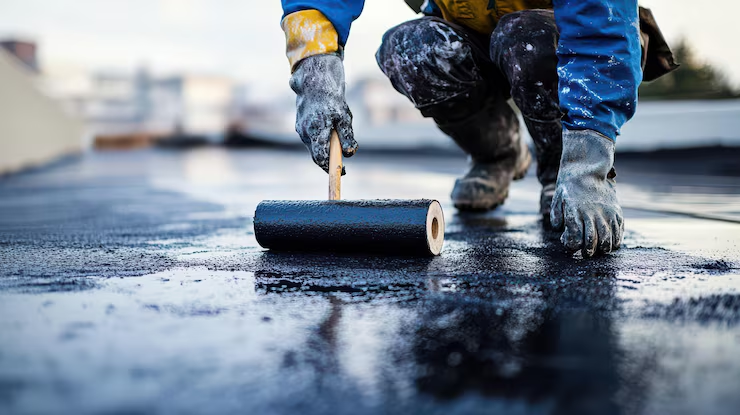
Table of Contents
Why Pakistan Needs Waterproofing More Than Most Countries
Pakistan’s climate and construction environment combine in a way that makes water damage unusually common and unusually severe.
Monsoon rainfall is intense and concentrated. The monsoon season between July and September delivers most of Pakistan’s annual rainfall in a short window. Major cities routinely record 50 to 100 millimeters of rainfall in a single day during peak monsoon. Flat roofs, which are standard across Pakistani residential construction, collect standing water that applies constant pressure on every crack and imperfection in the concrete surface.
Temperature extremes cause structural movement. Summer temperatures above 40 degrees Celsius in Lahore, Multan, and Karachi cause concrete and masonry to expand significantly. Night temperatures bring contraction. This daily cycle creates micro-cracks in concrete and plaster over time. Those cracks, invisible at first, become water entry points.
Construction quality is inconsistent. In Pakistan’s rapidly growing construction market, waterproofing is frequently skipped or treated as an optional finishing step rather than a structural necessity. Buildings are handed over to owners without proper waterproofing at key vulnerable points. Problems then emerge within the first few monsoon seasons.
Urban drainage is often inadequate. Poor street drainage means water sits against building foundations and walls longer after rain events than it would in a city with better infrastructure. This extends the duration of water pressure on building surfaces.
The Pakistan Meteorological Department documents that monsoon rainfall intensity has increased across key provinces in recent years. Buildings that were marginally waterproofed a decade ago face higher rainfall loads today.
All of this creates a country where waterproofing is not a premium upgrade. It is basic protection that every building needs.
What Waterproofing Actually Does
Waterproofing is the process of treating a building surface so that water cannot penetrate it. The surface might be a concrete roof slab, a bathroom wall, a basement floor, an exterior wall, or any other part of the building that faces water pressure.
The treatment creates a barrier. Depending on the type of waterproofing, that barrier works in one of three ways.
A surface coating forms a continuous film on top of the building material. Water cannot pass through the film. The film must be seamless, meaning it covers the entire surface with no gaps, because any gap becomes a leak point.
A penetrating treatment works differently. Instead of coating the surface, it absorbs into the concrete or masonry and chemically reacts with the material to block the microscopic pores through which water would normally travel. The treatment becomes part of the structure itself.
A membrane system uses a physical sheet or thick layer of material that is bonded to the surface. Water cannot pass through the membrane. This is the most heavy-duty approach and is used where water pressure is highest, such as below-ground foundations.
Each type has its place in Pakistan’s construction environment. Understanding which type suits which location is the core of making good waterproofing decisions.
The 4 Waterproofing Methods Used in Pakistan
Liquid Membrane Waterproofing
This is the most practical and widely used method for residential and light commercial buildings in Pakistan. A liquid compound is applied to the surface with a brush, roller, or spray. When it dries, it forms a continuous, flexible, water-resistant film.
The key advantage is that it covers the entire surface without joints or seams. Seams are where most waterproofing systems eventually fail. A correctly applied liquid membrane has no seams.
Liquid membrane products are also flexible after drying. This matters because concrete rooftops and walls in Pakistan expand and contract with temperature. A flexible membrane moves with the surface instead of cracking. Rigid coatings crack under movement and let water in through those cracks.
Liquid membrane products are suitable for roofs, terraces, bathroom floors and walls, balconies, water tank outer surfaces, and basements. They are ready to use with minimal equipment and are practical for both professional contractors and skilled DIY users.
SB Hydra Shield Waterproof Anti Leakage Agent by StoneBird Chemicals is a liquid-applied waterproofing compound manufactured in Pakistan for Pakistan’s specific climate conditions. It is certified to EN 14891 for liquid-applied waterproofing systems and tested to ASTM D4541 for adhesion strength. It is ready to use, covers approximately 100 square feet per kilogram per coat, and is available in 1 kg, 2 kg, 3 kg, and 5 kg packs.
Cementitious Waterproofing
Cementitious waterproofing is a cement-based compound, sometimes called a slurry coat, mixed with water and polymer additives and applied directly to concrete or masonry surfaces. It bonds strongly with concrete substrates and is a reliable choice for areas in direct contact with water over long periods.
Its primary applications in Pakistan are water tanks, basements, swimming pools, and wet area walls. It is also used as a base layer beneath liquid membranes on rooftops for enhanced protection.
The limitation of plain cementitious waterproofing is that it is not very flexible. On large exposed rooftop surfaces that experience significant thermal movement, a cementitious-only approach may develop hairline cracks over time. For these areas, polymer-modified cementitious products, which add flexibility to the cement base, are the better choice.
Bituminous Waterproofing
Bituminous products, derived from petroleum, are very strong water barriers. They come as liquid coatings or as sheet membranes that are bonded to surfaces using heat or adhesive.
In Pakistan, bituminous sheet membranes are used mainly on large flat commercial and industrial rooftops and on below-ground foundations where water pressure is highest. The sheets are overlapped and heat-welded at joints to create a seamless system.
The limitations for residential use are cost and installation complexity. Bituminous sheet installation requires professional applicators with torching equipment. For most residential rooftops, liquid membrane systems achieve comparable protection at lower cost and with simpler application.
Bituminous coatings also require a protective layer on top when used on rooftops, because unprotected bitumen becomes brittle under extended UV and heat exposure in Pakistan’s climate. A screed or tile finish over the membrane extends its service life significantly.
Polymer Modified Waterproofing
Polymer modified systems represent the most advanced and durable waterproofing available for Pakistan’s conditions. They can be cementitious or liquid-based, but both types have polymer additives that improve flexibility, crack-bridging ability, adhesion, and resistance to temperature cycling.
Polymer modification allows a waterproofing compound to stretch slightly when the substrate moves due to heat or load, then return to its original form. This prevents the cracking that limits the lifespan of plain cementitious products. It also improves adhesion to a wider range of substrates, including surfaces that may have minor contamination or irregular texture.
For rooftops, balconies, and exteriors in Pakistan where temperature extremes are most severe, polymer modified systems consistently outperform other types in long-term durability. For a detailed comparison of liquid membrane versus physical membrane approaches, see our guide on chemical vs membrane waterproofing: detailed comparison.
Where Each Method Is Used in Pakistani Buildings
Flat roofs and terraces need flexible liquid membrane or polymer modified waterproofing applied in at least two coats over a clean, crack-free surface. The most common failure here is insufficient coat thickness and untreated edges and joints.
Bathrooms and wet areas need waterproofing applied before tiles Installation guide . The liquid membrane goes directly on the floor and walls before any tile adhesive. Once tiles cover the surface, there is no practical way to add this layer without full tile removal. For a full application guide, see our article on step-by-step waterproofing before tile installation.
Basements face groundwater pressure from all sides. They need either a strong cementitious system applied to interior walls, or a membrane system applied to exterior walls during construction before soil is backfilled. Once construction is complete and soil is in place, external waterproofing of a basement becomes extremely difficult. This makes construction-stage application non-negotiable. See our detailed guide on basement waterproofing common problems and permanent solutions.
Exterior walls are treated with liquid membrane or masonry waterproofing compounds that penetrate the plaster surface and seal it against rain penetration. This is particularly important in areas facing prevailing rain direction and in older buildings where plaster has developed hairline cracks over years of thermal movement.
Water tanks require waterproofing on their outer surfaces before plastering to prevent seepage into adjacent walls and slabs. Only products with confirmed non-toxicity should be used on the interior surfaces of potable water tanks.
Balconies are one of the most frequently neglected waterproofing zones in Pakistani homes. Water that penetrates a balcony floor travels through the slab and appears as staining or dripping on the ceiling below. A liquid membrane applied to the structural slab surface before any tiles or finish goes down protects the slab and the room beneath it.
How to Read Waterproofing Product Standards
When choosing a waterproofing product in Pakistan, the testing standards cited on the product packaging tell you whether performance claims are verified or just marketing language.
EN 14891 is the European standard for liquid-applied waterproofing systems used under tile. A product certified to this standard has been tested for water tightness, bond strength after water immersion, crack bridging, and performance under freeze-thaw cycling. For bathroom floor waterproofing in Pakistan, EN 14891 certification is a meaningful quality indicator.
ASTM D4541 measures pull-off adhesion strength, how firmly the waterproofing coating bonds to the substrate. Higher values mean the coating stays attached to the surface under water pressure and mechanical stress.
ASTM D4060 measures abrasion resistance, relevant for waterproofing on surfaces that receive foot traffic.
ASTM D412 tests tensile and elastomeric properties, measuring how much a coating stretches before it breaks. Higher elasticity values mean better crack-bridging performance.
Products that cite none of these standards and offer no test data should be treated with caution. In Pakistan’s market, some products are marketed on price alone with no independent performance verification.
The Complete Application Process for Liquid Waterproofing
Understanding the application process helps you verify whether a contractor is doing the job correctly, or guides you through a DIY application on a manageable area.
Step 1: Inspection and surface preparation. Walk the entire surface. Mark all visible cracks, low spots where water pools, areas where old waterproofing has failed, and junctions at parapet walls and drain openings. This inspection determines how much crack repair work is needed before waterproofing can begin.
Step 2: Repair all cracks and defects. Fill every crack, gap, and surface defect with a cement patching compound or polymer-modified mortar. Pay particular attention to the internal corner where the floor meets the wall, and around all drain and pipe penetrations. Waterproofing film cannot bridge open cracks. All cracks must be solid before the membrane goes on.
Step 3: Clean the surface completely. Remove all dust, loose material, old paint, oil, and any chemical residue. Any contamination between the waterproofing compound and the substrate breaks the bond. Scrub with a stiff brush and water. Allow the surface to dry fully.
Step 4: Apply the primer coat. Dilute the liquid waterproofing compound at 1:1 with clean water for the primer coat. This thinner mix penetrates the surface pores and creates a base that improves the adhesion of subsequent full coats. Apply evenly with a brush, working it into corners and edges.
Step 5: Allow full drying between coats. This step is the one most often skipped in Pakistan. Allow 6 to 12 hours drying time between each coat. A coat applied over a wet coat traps moisture and blisters. In summer heat, drying is faster. During humid monsoon months, allow the full 12 hours.
Step 6: Apply the first full coat undiluted. Apply the product straight from the container. Use a brush at corners, edges, and penetrations. Use a roller on open surfaces for consistent coverage. Apply at approximately 1 kg per 100 square feet.
Step 7: Apply the second coat in the opposite direction. Crossing the application direction ensures any thin patches from the first coat are covered by the second. Two coats is the minimum for any exposed surface. Three coats for rooftops, balconies, and areas with drainage problems.
Step 8: Allow 24 hours before tiling or foot traffic. Do not begin tile installation or allow walking on the surface until the final coat has fully cured.
Common Waterproofing Mistakes in Pakistan
Understanding what goes wrong helps you avoid the same outcomes on your project.
Applying waterproofing on a damp surface. The most common cause of early coating failure. The compound bonds to moisture instead of concrete. It peels off within weeks.
Not filling cracks before coating. Cracks continue to move with temperature. A film applied over an unfilled crack tears at that point regardless of how well the rest of the surface is protected.
Applying only one coat on an exposed surface. A single coat is not sufficient for surfaces under standing water or direct monsoon rain. Two coats minimum, three for high-exposure zones.
Neglecting edges and junctions. Parapet wall bases, drain openings, and pipe penetrations are where most roof leaks begin. Extra time and extra product at these points prevents the most common failure locations.
Tiling immediately after waterproofing. Tile adhesive compresses a coat that has not cured and breaks the film structure. Always wait the full curing time.
For a full review of these errors and how they compound over time, see our guide on top 9 waterproofing mistakes homeowners make.
Waterproofing and Tile Installation: The Correct Sequence
In bathrooms, kitchens, and balconies, waterproofing and tile installation are directly connected. The waterproofing layer is applied first to the bare substrate. It cures. Then tile adhesive is applied on top of the waterproofing layer, and tiles are fixed on top of that.
This sequence means tiles sit on a protected surface. Water that passes through grout lines reaches the waterproofing film and cannot go further. Without this layer, water accumulates behind the tiles, weakens the tile adhesive bond, and causes the tile failures that Pakistani homeowners deal with so frequently.
For bathrooms, SB Hydra Shield is applied to the floor and walls up to 1.8 meters height before any tiles go down. Once it cures, SB Grip Tile Bond C1T handles standard ceramic tile installation. For larger format tiles in commercial bathrooms or wet areas, SB Pro Tile Bond C2TE provides the improved bond strength and slip resistance needed for heavy tiles on waterproofed surfaces.
These three products working in sequence, waterproofing layer, tile adhesive, and tiles, create a complete system where each component does its specific job.
How Long Does Waterproofing Last in Pakistan’s Climate?
No waterproofing lasts forever, but a properly applied system on a well-prepared surface gives meaningful service life before reapplication is needed.
Liquid membrane systems applied in two to three coats on a clean rooftop typically last three to five years under Pakistan’s conditions. Polymer modified systems, with their superior crack-bridging and flexibility, can extend this to seven to ten years on a well-maintained surface.
The single biggest factor affecting lifespan is surface preparation. A perfectly applied coat on a poorly prepared surface fails early. A good coat on a properly prepared surface delivers the full expected lifespan.
Annual inspection after monsoon season, roughly October to November, is the best maintenance habit. Catching a small area of peeling or cracked coating early and touching it up costs almost nothing. Allowing a failed area to grow means eventually redoing the entire surface.
Choosing the Right Product for Your Situation
For rooftops, balconies, bathroom floors and walls, water tank outer surfaces, and basement interior walls in residential and light commercial construction: SB Hydra Shield Waterproof Anti Leakage Agent is a ready-to-use liquid compound certified to EN 14891 and tested to ASTM D4541, manufactured in Lahore specifically for Pakistan’s climate.
For areas requiring tile installation on top of waterproofing: follow with SB Grip Tile Bond C1T for standard tiles or SB Pro Tile Bond C2TE for large format, marble, or porcelain tiles.
For project-specific guidance on quantities, application method, or distributor locations, visit the StoneBird Chemicals distribution page or contact their technical team directly.
The Bottom Line
Waterproofing in Pakistan is not a luxury finish. It is the protection layer that stands between a building and the damage that Pakistan’s monsoon rains, extreme heat, and high humidity cause. Every method has its purpose. Every application has its process. And every building that skips this step pays for it sooner or later in repairs that cost far more than the protection would have.
The right time to waterproof is always before the problem appears, not after.